
Every row and column carries its own clue. A single number like 7 means one unbroken block of seven filled cells somewhere in that line. A clue like 4 2 means a block of four, then at least one empty cell, then a block of two — in that exact order, reading left-to-right or top-to-bottom.
Before touching your pencil, scan the whole grid once. You are not solving yet; you are meeting the puzzle. Notice the big numbers, the empty rows (clue 0), and the lines that look almost full.
Big clues are gifts. In a 10-cell row, a clue of 10 fills the whole line instantly. A clue of 9 leaves only two possibilities — and eight of the ten cells are filled in both, so you can mark them immediately.
This is the golden rule of nonograms: work from certainty, never from hope. Fill only the cells that must be filled in every possible arrangement.
Take a clue of 6 in a 10-cell row. Slide the block as far left as it can go: it covers cells 1–6. Now slide it as far right: cells 5–10. Compare the two positions — cells 5 and 6 are covered in both. Whatever happens, those two cells are filled. Mark them.
Repeat this mental slide on every promising line. The overlap method alone unlocks most beginner and intermediate puzzles — it is the technique our Volume 1 teaches grid by grid.
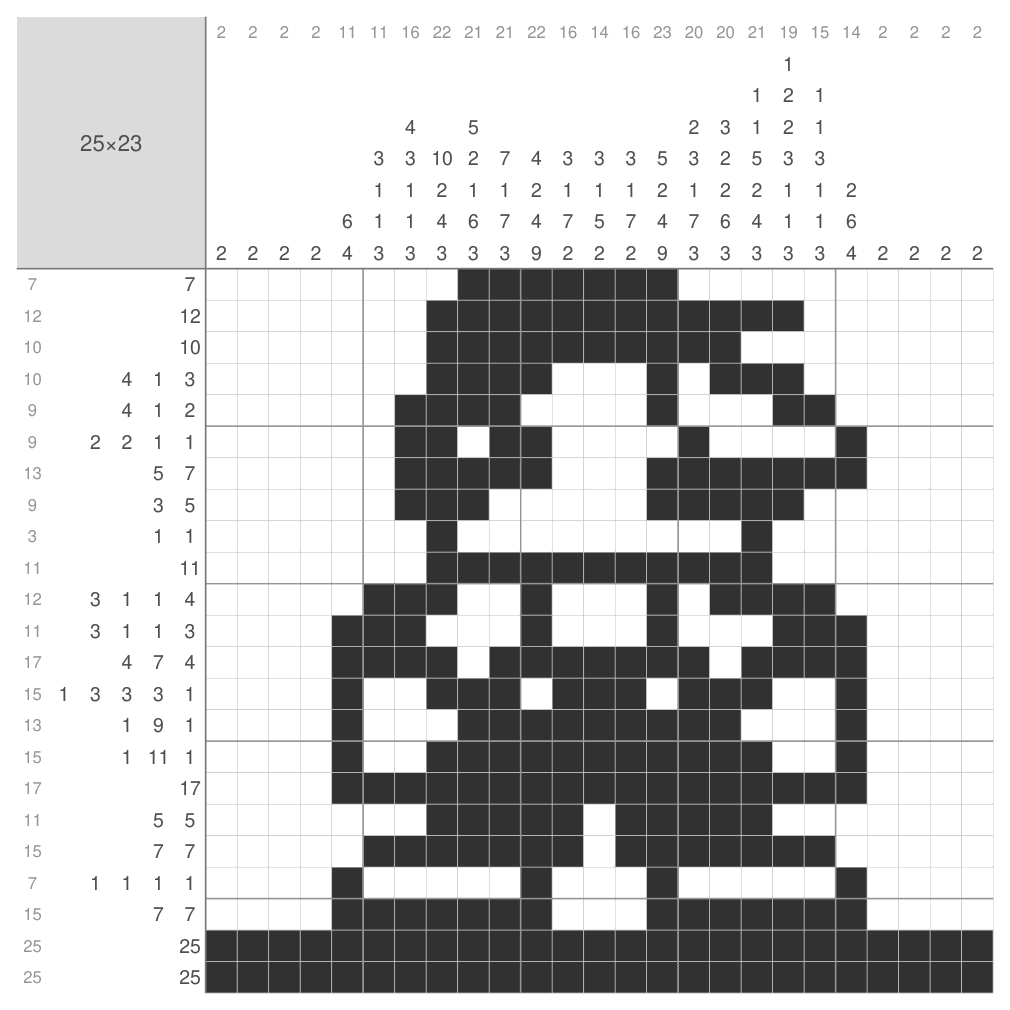
Beginners chase filled squares; solvers hunt empty ones. When a block is complete, cross out the cells around it. When a cell is too far from any possible block, cross it out. Every X narrows the puzzle, and a line full of X's often solves its neighbours for free.
Use a light pencil dot or a small ×. Your future self, four deductions later, will thank you.
When a filled cell touches the border, the clue nearest that border becomes anchored: you know exactly where its block starts. Extend it, close it with an X, and watch the certainty ripple across the grid — every completed line feeds new information into the columns it crosses, and the puzzle starts solving itself.
This rhythm — row, column, row again — is what solvers call chaining. It is also where the deep calm of nonograms lives.
Download 15 free hand-curated nonograms and try every technique from this guide today.
Most people solve their first 10×10 grid within fifteen minutes of learning the rules. Comfort with the overlap method usually arrives within a handful of puzzles — which is why our books open with a gentle warm-up section.
Start at 10×10. It is big enough to feel the logic and small enough to finish with a smile. Climb to 15×15 and 25×25 as the techniques become second nature.
In a well-made nonogram, never — and that is the beauty of it. If you feel stuck, there is always a logical move hiding somewhere; rotating between rows and columns almost always reveals it.
From relaxing beginner grids to master-level challenges — each puzzle hand-curated, each book crafted as an object to keep.
See the collection