
5 Mistakes Every Nonogram Beginner Makes (and How to Fix Them)
The five habits that stall almost every new solver — and the small fixes that turn guessing into deduction.
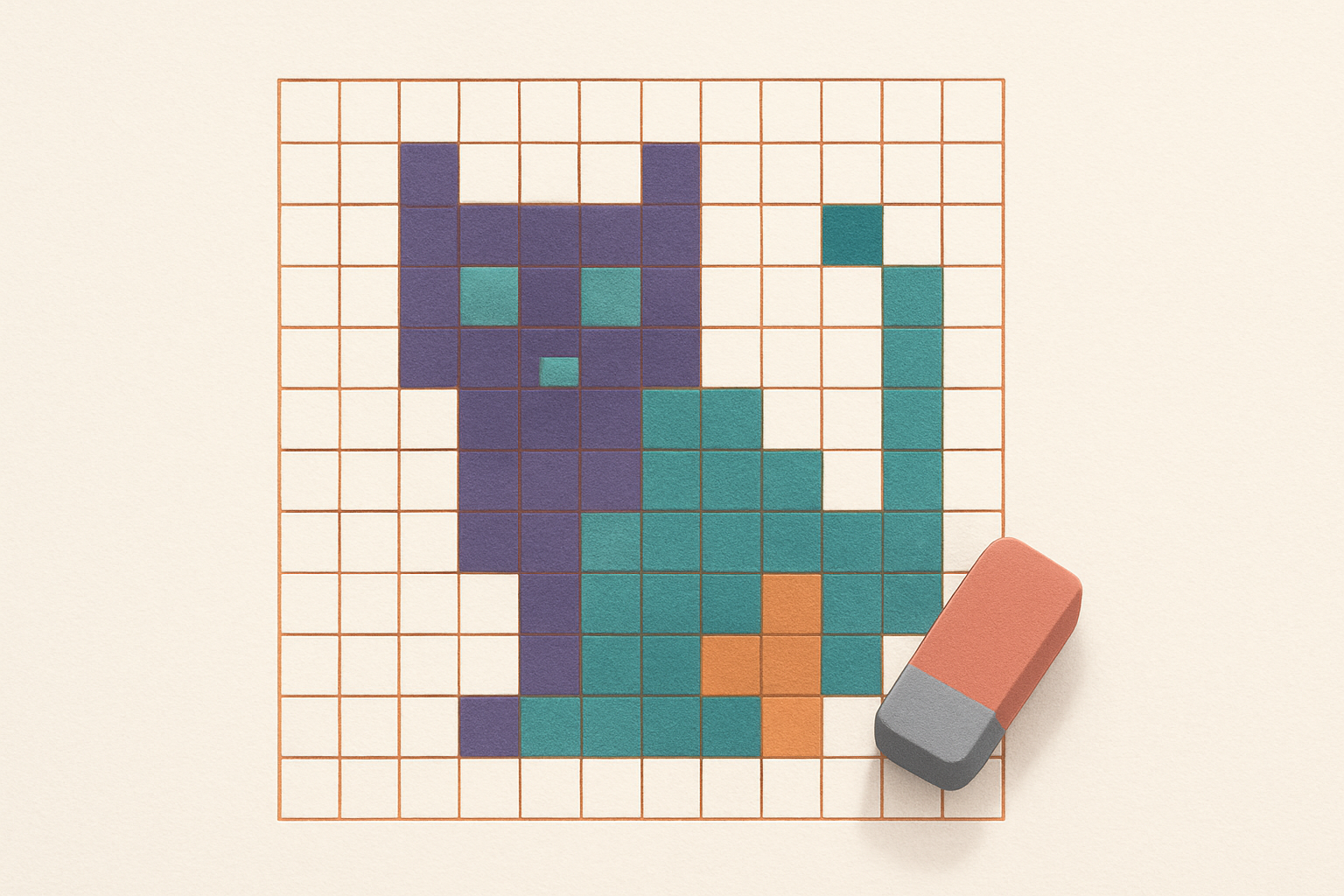
Almost everyone hits the same wall when they start solving nonograms. The puzzle looks simple — a grid, a few numbers — and then, twenty minutes in, nothing lines up and the picture refuses to appear. Nine times out of ten, it is not the puzzle. It is one of five habits, and every one of them is easy to unlearn.
We design these puzzles for a living, and we watch beginners make the same handful of mistakes over and over. Here they are, with the small fix for each.
1. Guessing instead of deducing
This is the big one. A cell looks like it should be filled, so you fill it — and now you are building on sand. Nonograms are pure logic: for every square, there is a reason it is filled or empty, and that reason is always findable from the clues you already have.
The fix: never colour a cell you cannot justify. If you cannot explain why it must be filled, leave it. A slower solve with zero guesses beats a fast solve you have to unpick.
2. Never marking the empty cells
Beginners obsess over the filled squares and completely ignore the blank ones. But knowing a cell is definitely empty is just as powerful as knowing it is filled — often more so, because it fences in where the filled runs can go.
The fix: mark known-empty cells with a light dot or an X. Those marks do half the deduction for you. When a row is boxed in by X’s on both sides, the numbers frequently have only one place left to sit.
3. Starting with the small numbers
It feels natural to begin with a gentle 1 or 2. But small clues are the least constrained — they can slide almost anywhere in the line, so they tell you almost nothing yet.
The fix: start with the biggest numbers, especially any clue larger than half the length of its row or column. Those are the squares the logic forces, and they give you your first certain cells to build from.
4. Skipping the overlap method
The single most useful technique in nonograms, and the one beginners most often miss. When a clue is large relative to its line, the filled run must cover some cells no matter where it ends up sitting — and those guaranteed cells are yours for free.
The fix: for a long clue, imagine sliding it as far left as it goes, then as far right. Any cell covered in both positions is definitely filled. We walk through this step by step in our guide to solving nonograms — it is worth ten minutes to learn properly.
5. Solving one line in isolation
You wring every last deduction out of a single row, get stuck, and give up on the whole puzzle. But a nonogram is a conversation between rows and columns: the cell you just filled in row 4 might be the clue that unlocks column 7.
The fix: after you make progress on a line, look at the rows or columns that cross it. Solving alternates — a little in the rows, a little in the columns, back and forth. When you are stuck, you are almost always looking at the wrong axis.
The pattern behind all five
Notice what these have in common: each one is a shortcut that trades certainty for speed. Nonograms punish that trade every time. The solvers who get fast are the ones who first got patient — who learned to fill only what they could prove, mark the blanks, and let the rows and columns talk to each other.
If you are just starting out, our primer on what a nonogram is covers the rules from scratch, and the step-by-step solving guide turns these fixes into a repeatable method. Do that, and the picture stops hiding.
Frequently asked
What is the best way to start a nonogram?
Begin with the largest clues in each row and column, and use the overlap method to find the cells that must be filled no matter what. Those give you a certain foundation to build on.
Should I mark empty squares in a nonogram?
Yes. Marking cells you know are empty (with a dot or an X) is one of the fastest ways to solve. Known-empty cells constrain where the filled runs can go.
Why do I keep getting nonograms wrong?
The most common cause is guessing — filling a cell you cannot fully justify from the clues. Fill only what you can prove, and cross-check rows against columns as you go.
The Logic Atelier publishes the books featured on this site. Some links lead to Amazon, where our titles are sold.

Maximiliano Leyton Gaggioli
Founder, editor and designer of The Logic Atelier. Trained as an architect, he designs the grids, tests every puzzle, draws the pixel art and answers the mail — the atelier is small on purpose.
More about the editorial →
Keep reading
One letter a month. Worth opening.
Every new article, puzzle techniques and atelier notes — straight to your inbox.