
The history of nonograms
From lit windows in 1980s Tokyo to Game Boy cartridges — and back to paper.
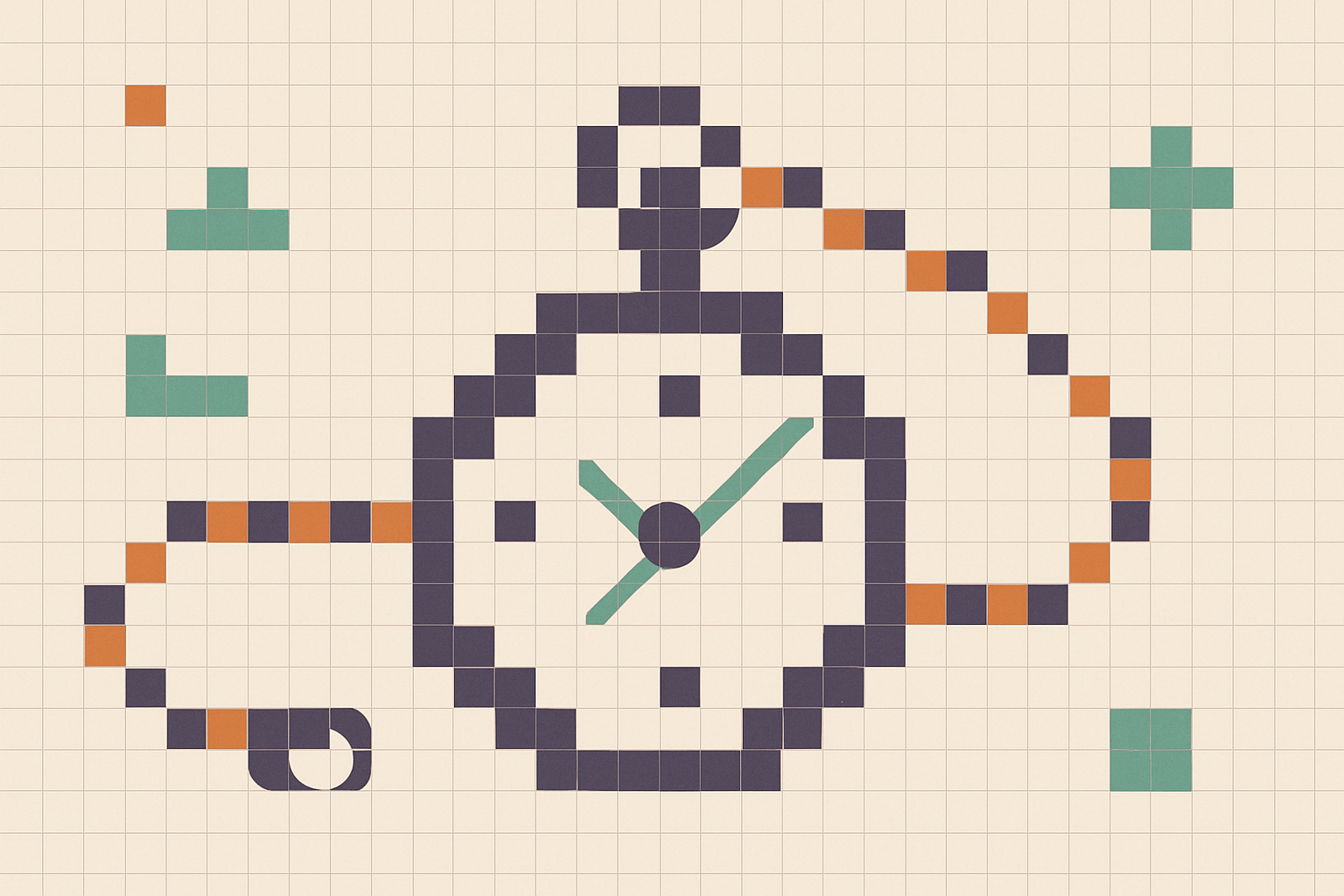
Every nonogram you solve today — on paper, on your phone, on a train — descends from apartment windows in 1980s Tokyo. The history of nonograms is short, strange and lovely, and it begins with a designer looking at a skyscraper after dark.
1987: pictures made of windows
Non Ishida, a Japanese graphics editor, saw what most of us miss: an office tower at night is a grid, and its lit and unlit windows are pixels. She created “window art” — images formed by switching building lights on and off — and in 1987 won a design competition in Tokyo with the idea. Around the same time, a professional puzzler named Tetsuya Nishio arrived at the same concept independently: pictures encoded in numbers, revealed by logic. Great ideas often have two parents.
1990: the puzzle gets a name
Ishida’s grid puzzles began appearing in Japanese magazines, and in 1990 they crossed the world: British puzzle editor James Dalgety introduced them to readers of a UK newspaper and coined the name that stuck — nonogram, from Non Ishida + diagram. The same puzzle would soon collect aliases everywhere it landed: Hanjie, Griddlers, Pic-a-Pix, Japanese crosswords.
1995: Nintendo presses start
The puzzle’s global breakthrough came in 1995, when Nintendo released Mario’s Picross for the Game Boy. “Picross” — picture crossword — became the name a whole generation learned first. The series never really stopped: new Picross titles have accompanied every Nintendo console since, quietly making the nonogram one of the most-played logic puzzles on Earth.
2000s–today: from apps back to paper
Smartphones turned nonograms into a daily ritual for millions, with endless free grids one thumb-tap away. And yet something curious happened on the way to total digitisation: solvers came back to paper. A printed grid asks for your full attention — no hints, no undo, no ads — and rewards it with the small, real satisfaction of a picture drawn by your own logic. That return to slow solving is exactly where The Logic Atelier lives: hand-curated grids, printed beautifully, solved with a pencil.
A 40-year-old idea that still feels new
From lit windows in Tokyo to a Game Boy cartridge to the book on your desk, the nonogram has survived every format change for one reason: the moment the picture reveals itself never gets old. If you have never felt it, learn to solve your first grid — or download fifteen free puzzles and meet the puzzle where it works best: on paper.
The Logic Atelier publishes the books featured on this site. Some links lead to Amazon, where our titles are sold.

Maximiliano Leyton Gaggioli
Founder, editor and designer of The Logic Atelier. Trained as an architect, he designs the grids, tests every puzzle, draws the pixel art and answers the mail — the atelier is small on purpose.
More about the editorial →
Keep reading

One letter a month. Worth opening.
Every new article, puzzle techniques and atelier notes — straight to your inbox.