
Which Grid Size Should You Start With? A Level Guide
Six rungs from 10×10 to 55×55 and beyond — what each one costs in time, which technique it forces you to learn, and why the number on the box is a poor guide to how hard the puzzle will be.
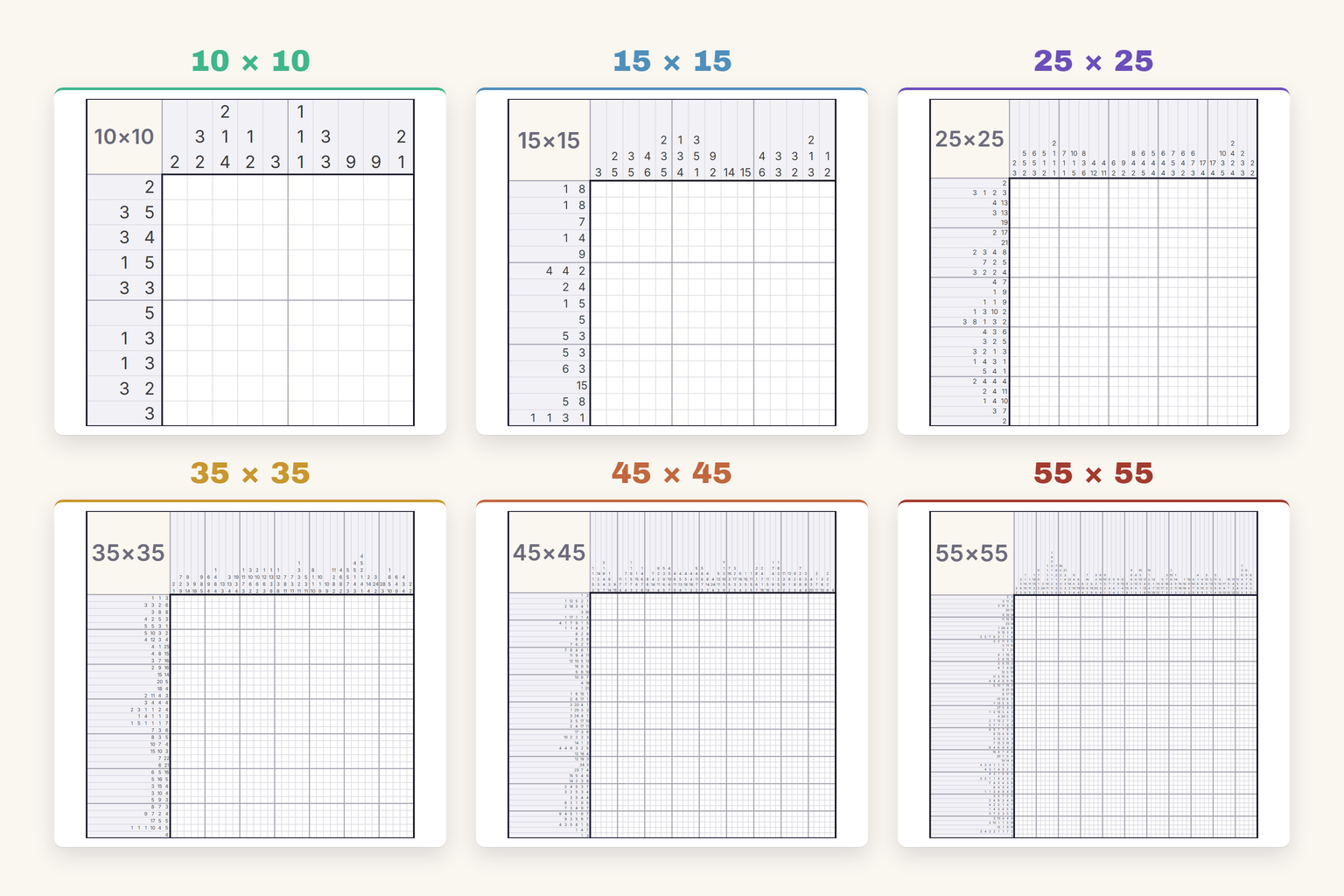
Every nonogram app and every puzzle book opens on the same menu, and it is the one screen nobody explains: 10×10, 15×15, 25×25, and on up. The sizes read like volume settings, a little more of the same thing at each notch. They are not. Between the first rung and the sixth the board grows thirty-fold, and somewhere in the middle the puzzle stops being a larger version of itself and becomes a different activity with different habits.
The short answer: start at 10×10 if you have never finished one, and at 15×15 if you have finished a few and want the first grid that can teach you something. The rest of this is the part worth your time — what each rung costs, which technique it forces you to learn, and why the number printed on the box predicts difficulty so badly.
A step up the ladder multiplies the board
Take the arithmetic seriously, because it explains why the jumps feel steeper than they look. A grid is an area. Ten by ten is 100 cells; fifteen by fifteen is 225. That step reads as “fifty per cent bigger” and is in fact 2.25 times the board. Carry it up: 625 cells at 25×25, 1,225 at 35×35, 2,025 at 45×45, 3,025 at 55×55. The width has grown by five and a half; the work has grown by thirty.
The clue lines tell the same story from the other side. A 10×10 has twenty lines to keep in your head, ten rows and ten columns. A 55×55 has a hundred and ten, and every one of them can be reopened by a single mark landing in a crossing line. This is not a metaphor for difficulty. In the standard formal treatment, a puzzle solvable by line reasoning alone is measured by how many complete passes over all rows and columns it takes to finish, and the ceiling on that count is the number of cells plus one. The worst case scales with area, not with width.
Where these six sizes actually come from
There is no standards body for nonograms and no official ladder. The sizes are publishing conventions that hardened over thirty years. Nintendo’s Mario’s Picross shipped in 1995 with three tiers — 5×5, 10×10 and 15×15 — and its sequel that same year pushed the ceiling to 20×20 and 25×20. Newspapers settled on grids that fit a column; books settled on grids that fit a page without a magnifying glass.
Our own ladder runs 10, 15, 25, 35, 45, then 55 and above. The top rung is deliberately open-ended rather than a single size: from 55×55 up you are in expert territory, and the Master puzzles in our books run to 60×70 — 4,200 cells, forty-two times the beginner board. Treat the labels as a rough guide to the effort a well-made puzzle at that size will ask for, not as a guarantee. The next section is about why no size can carry that guarantee.
The level guide
| Level | Grid | Cells | What it teaches | One sitting |
|---|---|---|---|---|
| Beginner | 10×10 | 100 | Crossing out. Marking what cannot be filled, as diligently as what can. | 5–10 min |
| Easy | 15×15 | 225 | Single-clue lines. Counting a row to place one block exactly. | 10–20 min |
| Medium | 25×25 | 625 | Overlap. Packing a line both ways and keeping the intersection. | 20–35 min |
| Hard | 35×35 | 1,225 | Line scanning. Re-reading every line that has taken a mark since you last looked. | 35–55 min |
| Expert | 45×45 | 2,025 | Block interaction. Working out which clue owns a run, and what that forces elsewhere. | 1 h–1 h 20 |
| Master | 55×55 and up | 3,025+ | Case analysis. Assuming a value, propagating it, and keeping the opposite when it breaks. | 1 h 30–2 h+ |
The times are ours, not a measured average: they are what we design each tier around in our own books, for a solver who is comfortable at that level and works without interruption. A first attempt at any rung takes considerably longer, and that is the point of the rung.
Read the third column as the real curriculum. Each size is worth solving because of the technique it forces you to acquire; if a grid never makes you learn the next move, it is entertainment rather than progress. The five techniques above beginner level are set out properly in our guide to the techniques that crack hard nonograms, and the beginner habits underneath them in our guide to solving nonograms.
Size is a weak predictor of difficulty
Two nonograms of identical dimensions can differ enormously in how hard they are, and the evidence for this is unusually solid, because small nonograms are few enough to enumerate exhaustively. Batenburg and Kosters worked through all 33,554,432 possible black-and-white 5×5 images: 25,309,575 of them yield a puzzle with exactly one solution, and 98.7 per cent of those can be finished by line reasoning alone. Move to 6×6 — one extra row and one extra column — and that share drops to 97.7 per cent, while the sliver that resists both line reasoning and the simplest two-line argument more than doubles, from 0.06 to 0.14 per cent. The deepest line-solvable puzzle also gets deeper: 17 full passes at 5×5, 26 at 6×6.
So difficulty does climb with size, but as a distribution, not as a promise. Any given puzzle can sit anywhere in it. Jan Wolter’s benchmark set makes the point concretely: his 45×45 Swing is solvable line by line, while Mum, at 34×40 and barely half the area, cannot be finished without search. The larger puzzle is the easier one.
What moves difficulty more than size is density — the proportion of cells that end up filled. Work on randomly generated boards puts the hardest region at a fill of roughly two-fifths: below it almost nothing is deducible, above it almost everything is, and the effort peaks at the crossing. Size interacts with this rather than overriding it. On random grids the fill at which puzzles start to become solvable at all rises as the board grows, from around 30 per cent at 10×10 to around 50 per cent at 30×30. A sparse 45×45 landscape can fall out in an hour; a dense 25×25 portrait can hold you all evening.
How to choose, and when to move up
Pick the largest grid you can finish in one sitting. Not the largest you can finish — the largest you can finish without leaving it. A nonogram abandoned halfway is a nonogram restarted, because the state you were holding in your head does not survive the interruption, and rebuilding it from the marks on the page is most of the work again. This single rule matters more than any assessment of your own skill.
The signal to move up is not that you finished. It is that you finished without guessing and without erasing. Two clean solves in a row at one size means the technique that size teaches has become automatic, and an automatic technique stops paying attention. If you are erasing, the level below still has something for you; if you are guessing, go back a level and read the guide, because guessing is the one habit that gets more expensive at every rung.
One caution about jumping. The gaps in the ladder are not even: 15 to 25 nearly triples the board, and 25 to 35 is the step where most solvers stall, because it is where a single line stops being enough and you have to start reading pairs of crossing lines together. If you are going to skip a rung, skip 45 and not 25.
Frequently asked
Is a 55×55 just five 25×25s?
No, and the arithmetic says why: five 25×25 grids are 3,125 cells, about the same board as one 55×55. But the five are independent, and the one is not. In the large grid every mark can propagate across a hundred and ten lines, so the deductions available late in the puzzle depend on almost everything you have already done. That interconnection is the difficulty, and it does not exist in the five small puzzles at all.
I finish 15×15 comfortably but 25×25 stops me. What changed?
Slack. On a small grid the clues are long relative to the row, so blocks are pinned early and overlap gives cells away on the first pass. On a 25×25 the same clue sits in a much longer line, forces nothing on its own, and only starts paying once a crossing column has delivered a mark. The move you are missing is not a harder technique but a habit: re-run every line that has taken a mark since you last looked at it.
Do larger grids make better pictures?
They make more detailed ones, which is not the same thing. Resolution buys recognisable faces and text, but it also buys large empty regions, and empty regions are where a puzzle goes slack and dull. The best-designed large nonograms keep the fill dense enough to stay deducible, which is why so many of them are dark silhouettes rather than fine line drawings.
Are the sizes the same in picross, griddlers and hanjie?
The conventions differ by publisher, but the puzzle does not — those are four names for one thing. Video game adaptations tend to cap lower than print, because a 55×55 grid is painful on a handheld screen. Where the whole family sits is laid out in our map of logic puzzles.
Where this comes from
Puzzle sizes get quoted with more confidence than the evidence supports. Here is what we checked, and where, so you can weigh it yourself.
- Batenburg and Kosters, On the Difficulty of Nonograms (2012) The source of every enumeration figure in this post. Published in the ICGA Journal, volume 35, number 4, pages 195-205. The authors worked through all 33,554,432 black-and-white 5×5 images and all 68,719,476,736 6×6 images, computing for each the difficulty of the resulting puzzle, which is what makes the 98.7 and 97.7 per cent figures exact counts rather than estimates. They also supply the difficulty measure used here: the number of complete passes over all rows and columns needed to finish a line-solvable puzzle, bounded above by the number of cells plus one. Two honest limits. Exhaustive enumeration stops at 6×6, so every statement about larger boards in the paper rests on sampling. And the images are generated, not designed by a human, which is precisely why the density figures describe random grids rather than the puzzles you buy. The published version sits behind the publisher’s paywall under DOI 10.3233/ICG-2012-35402; we link the authors’ full text at Leiden University instead, because a citation nobody can open is not a citation. On the Difficulty of Nonograms (full text, PDF, Leiden University).
- Jan Wolter, Survey of Paint-by-Number Puzzle Solvers The source of the Swing and Mum comparison. Wolter benchmarked solvers against a fixed set of sample puzzles and published each one’s dimensions alongside whether it can be solved line by line or requires search: Swing at 45×45 is line solvable, Mum at 34×40 is not. That pairing is the clearest public counterexample to the assumption that the bigger grid is the harder puzzle. The survey also carries the breakdown we have cited before, from a snapshot of the webpbn.com database taken on 2 October 2009: of 2,491 human-designed black-and-white puzzles, 81.8 per cent were unique and line solvable. Read it as a large collection of user-submitted puzzles rather than a publisher’s catalogue. Survey of Paint-by-Number Puzzle Solvers (webpbn).
- Batenburg, Henstra, Kosters and Palenstijn, Constructing Simple Nonograms of Varying Difficulty (2009) Published in Pure Mathematics and Applications, volume 20, pages 1-15. The reason we can say that size is a design parameter and difficulty is a separate one: the paper gives an algorithm that takes a single grey-level image and generates from it a set of nonograms of deliberately different difficulties, all at the same dimensions and all resembling the same picture. It also constructs the asymptotically hardest puzzles of the line-solvable type. The linked file is the authors’ own copy hosted at Leiden University and carries no journal pagination. Constructing Simple Nonograms of Varying Difficulty (PDF).
- Batenburg and Kosters, Solving Nonograms by combining relaxations (2009) Pattern Recognition, volume 42, issue 8, pages 1672-1683. The peer-reviewed source for the terminology: it gives the formal per-line operation, establishes that the order in which lines are processed does not change the result, and fixes the word simple for what solvers call line solvable. We cite it here so that the vocabulary in this post matches the vocabulary in the rest of the series. The linked file is the authors’ preprint rather than the published version. Solving Nonograms by combining relaxations (PDF).
- Foote and Krizanc, Nonogram: Complexity of Inference and Phase Transition Behavior (2025) The source for the two-fifths density figure. Section 3 reports a threshold of roughly 0.39 to 0.42, measured as a SAT solver’s propagation effort on randomly generated boards, with the work peaking at the transition itself. The caveat matters for a post about choosing a grid: this is machine effort on random boards, not human effort on designed puzzles, and it is a preprint rather than a journal publication. We quote it as the shape of the relationship, not as a number to aim at. arXiv:2507.07283.
- Mario’s Picross and Mario’s Super Picross (Nintendo, 1995) The source for the commercial size conventions. The Game Boy original offered 5×5, 10×10 and 15×15 grids selected by difficulty; the Super Famicom sequel released the same year raised the ceiling to 20×20 and 25×20. These are wiki references rather than primary documentation, which is why we checked the claim against two independent wikis before using it; the games themselves are the primary source and are still playable. We cite them only for what sizes were published, not for any claim about difficulty. Mario’s Picross (Wikipedia) · Mario’s Super Picross (Super Mario Wiki).
The Logic Atelier publishes the books featured on this site. Some links lead to Amazon, where our titles are sold.

Maximiliano Leyton Gaggioli
Founder, editor and designer of The Logic Atelier. Trained as an architect, he designs the grids, tests every puzzle, draws the pixel art and answers the mail — the atelier is small on purpose.
More about the editorial →
Keep reading
One letter a month. Worth opening.
Every new article, puzzle techniques and atelier notes — straight to your inbox.