
Sudoku, Kakuro & Nonograms: A Map of Logic Puzzles
There are only a handful of real families of logic puzzle, and each one is defined by the rule that does the work. A map of the territory, and where sudoku, kakuro and nonograms sit on it.
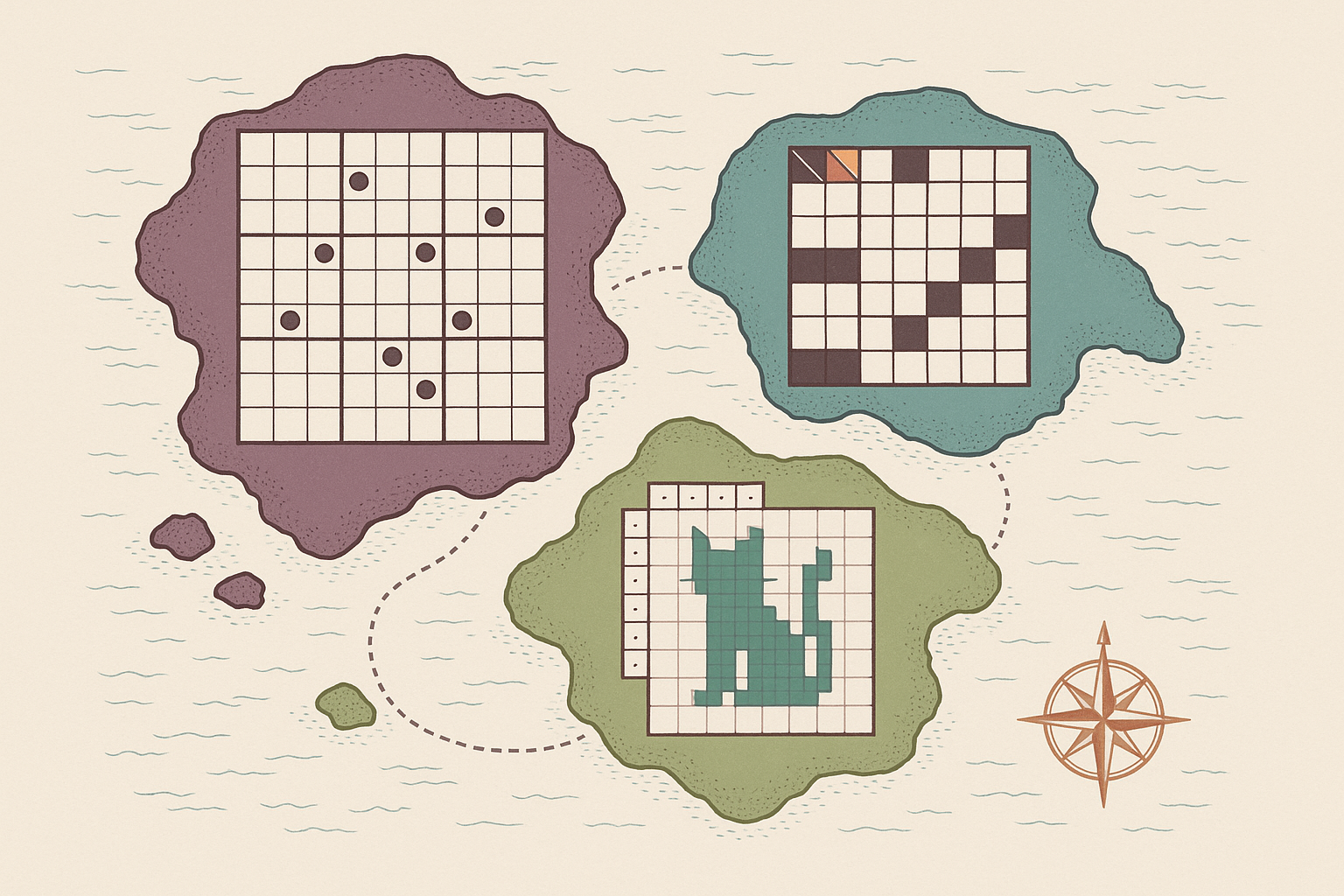
The short version: sudoku, kakuro and nonograms are not three hobbies. They are three constraints printed on the same object — a grid you complete by deduction, using only what is on the page. Sudoku says once each. Kakuro says add up to this. Nonograms say this many in a row. Name the constraint and you can read a puzzle you have never seen before, published in a language you do not speak.
We publish nonogram books for a living, which means we spend our days in one small room of a much larger house. This is the map of the house, and the first of our logic puzzle guides.
What actually makes a puzzle a logic puzzle
Everything you need is on the page — no trivia, no vocabulary, no cultural knowledge — and there is one intended answer, reachable by deduction rather than trial and error. Nikoli, the Japanese publisher that named and popularised many of these puzzles, sells its catalogue on exactly that basis. It is a standard good publishers hold themselves to, though, not a law: the World Puzzle Federation promises only that most competition puzzles are logic-based and culture-neutral. A puzzle that forces a guess is not a different species; it is usually one that was not finished properly.
The map: the main types of logic puzzle, sorted by constraint
Puzzle names are accidents — of geography, of which magazine got there first, of who registered a trademark. The constraint is durable. So when you meet a grid you do not recognise, ask one question: what do the clues constrain? The answer puts you in a family, and the family is where the techniques live.
Once each — the Latin-square family
Sudoku, futoshiki, KenKen. Each symbol appears exactly once in every row and column, and in sudoku in every 3×3 box; computer scientists group these as Latin square completion-type puzzles. The digits are labels, not quantities: print sudoku in nine colours and nothing changes.
Totals — grids clued by arithmetic
Kakuro, Japanese Sums, KenKen again. A group of cells must hit a stated target — a sum in kakuro; in KenKen, a value reached by any of the four arithmetic operations.
Fill or leave blank — shading puzzles
Nonograms, Nurikabe, Tapa, LITS. Every cell is binary, shaded or not, and the clues describe the size, shape or extent of the shaded region rather than its contents.
Draw the line — loop and path puzzles
Slitherlink, Masyu and Yajilin want one unbroken closed loop; Numberlink wants separate paths joining matching pairs. You draw rather than fill, and the clues constrain where the line may go.
Cut it into pieces — region division
Fillomino, Shikaku, Pentominous. The answer is a partition, and the clues say how big or what shape each piece must be. In Shikaku, the cleanest case, every rectangle holds one number, and that number is its area.
Put the objects somewhere — object placement
A fixed inventory — so many ships, so many stars — and clues counting how many fall in each row and column. If you have ever hunted battleships across a grid, you have solved one.
Two warnings. There is no canonical taxonomy: Nikoli lists its roughly forty-seven puzzle types alphabetically with no families at all, Grandmaster Puzzles uses six categories and files kakuro under Number Placement, the Janko archive in German uses five others. And the families overlap: KenKen is a Latin-square puzzle and an arithmetic one at once, and a whole branch — the verbal problems sold as “Einstein’s Riddle” — sits off the grid entirely. Draw the map as overlapping regions, not as boxes.
Sudoku: once each, three times over
The rule is two lines long: place a digit from 1 to 9 in each empty cell so that every row, every column and every bold-bordered 3×3 block holds all nine digits. No operation on the numbers is involved — as Scientific American put it in 2006, sudoku demands “not an iota of mathematics.” The signature move is elimination: find the cell where every digit but one is already ruled out, place it, and watch that placement rule out others.
No arithmetic does not mean nothing mathematical: a completed sudoku is a Latin square of order 9 with one extra requirement bolted on. But that is structure, not descent. Leonhard Euler named and studied Latin squares in 1782 without inventing them, and no documented line runs from his work to the puzzle.
The real history is shorter and stranger. Sudoku was printed anonymously as “Number Place” in the American magazine Dell Pencil Puzzles and Word Games in May 1979, then renamed in Japan by Nikoli in 1984 — a publisher admirably blunt that it is “not our original puzzle” — and trademarked there and nowhere else. So Japanese rivals still call it Number Place, while the English-speaking world calls it by a Japanese name.
Kakuro: the crossword where the clues are totals
Kakuro looks like a crossword and behaves like one, except that the entries are digits and the clues are sums. Fill each white cell with a digit from 1 to 9, no zeros: a number above a diagonal slash totals the run to its right, a number below it the run going down, and no digit repeats within a run.
That last clause is the detail most accounts get wrong: the rule applies to the run, not the row, so a digit can appear several times along one line, provided black cells separate it into different entries. And unlike sudoku, a digit’s value is load-bearing. A 7 is worth seven.
None of which makes kakuro arithmetic homework: Nikoli, which trademarked the name in Japan, tells its own readers not to worry about the addition. The real skill is combination sense. There is exactly one way to make 16 from five different digits — 1+2+3+4+6 — so any five-cell run totalling 16 is settled as a set before you place anything. Then you intersect: a cell where two runs cross often has one digit surviving in both. It is set logic wearing an accountant’s coat.
Its history rhymes with sudoku’s: American first, as “Cross Sums,” then renamed in Japan 加算クロス, kasan kurosu, “addition cross,” contracted to kakuro. A Dell issue from mid-1966 already calls Cross-Sums “our popular” puzzle, so the widely copied claim that it was invented that year is wrong.
Nonograms: the constraint that draws
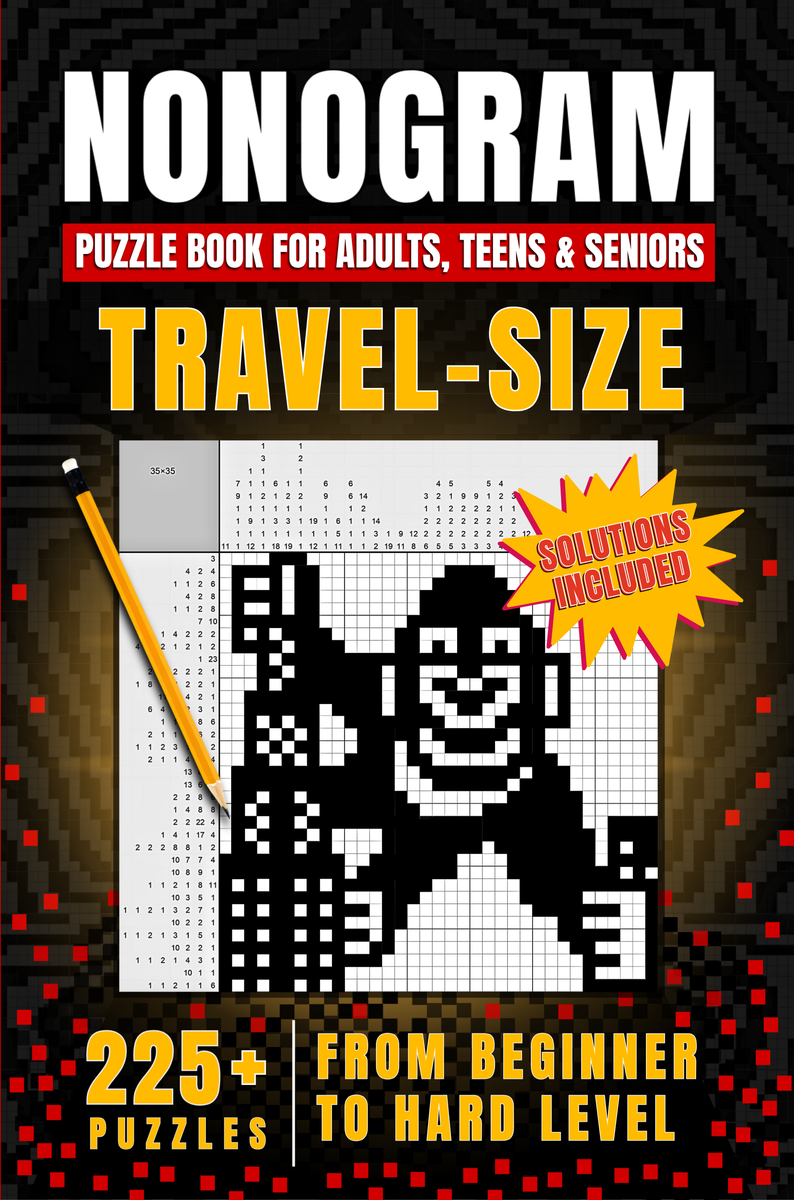
Numbers along the top and one side of an empty grid give the lengths of the blocks of filled cells in that line, in order, with at least one blank between them. A row clued 4 8 3 holds a run of four, then eight, then three. Shade correctly and a picture appears; there is a fuller introduction to nonograms in the guides.
The foundational deduction is overlap, and it is the moment a beginner sees the puzzle. Push a block as far left as it will go, then as far right; any cell covered both times must be filled. No arithmetic, no set intersection — just counting along a line. This is why nonograms feel spatial where sudoku feels categorical and kakuro feels combinatorial.
Two people invented the puzzle independently in Japan in 1988: Non Ishida, who arrived at it pictorially, and Tetsuya Nishio, who worked out how to number the hints. The English-speaking world remembers only Ishida, for a circular reason: the British collector James Dalgety coined “nonogram” from her name in 1990. Nishio deserves equal billing, and the evidence is in the history of nonograms.
One caveat: not every nonogram has a unique solution, and a puzzle that can be worked line by line without guessing is a gift from a careful constructor, not a property of the form. That is why guessing is the first of our five beginner mistakes.
Which should you try first?
A clearance first: we could find no evidence that any one of these is better for your brain than another. The large studies lump all “number puzzles” together and rely on self-reporting, and their reviewers said plainly that sharper brains may simply be likelier to do puzzles at all. We have been through that literature in can puzzles slow cognitive decline and do logic puzzles improve memory. Choose on taste, not on hope, and then keep at it.
If you like scanning and elimination, and the pleasure of noticing that only one digit can survive in a cell, start with sudoku. If you like sets and combinations, and the click of a run that can only be built one way, start with kakuro. If you think spatially, or want the solved puzzle to be something rather than merely finished, start with nonograms, the family growing fastest right now — and the one where you can start small, since a 5×5 nonogram is a real puzzle and a 5×5 sudoku does not exist. The beginner’s method takes ten minutes to learn.
Three constraints, one habit of mind. Whichever door you go in by, you are reading what the page has told you and following it until there is nowhere left to go. We work in the shaded grids, and there is a book of them waiting whenever you want a puzzle that leaves a picture behind.
Frequently asked
Is kakuro just sudoku with arithmetic?
No, though the family resemblance is real. In sudoku the digits are interchangeable symbols and no operation on them helps you; in kakuro their value is the constraint. And sudoku’s no-repeat rule covers a whole row, column or box, where kakuro’s covers one run of white cells between two clues.
Are Picross, Griddlers and Hanjie different puzzles?
Same puzzle, different names. The variation is in trademarks and newspaper branding, not in the rules, so if you can solve one you can solve them all. We untangle who named what in nonogram vs Picross vs Griddlers vs Hanjie.
Which is harder: sudoku, kakuro or nonograms?
Kakuro, for most beginners, but only at the start and only because the sums look like homework. Difficulty is really a property of the individual puzzle rather than the genre: every one comes in gentle and brutal versions.
Where this comes from
Puzzle history is full of confident claims that turn out to be second-hand. Here is what we checked, and where, so you can weigh it yourself.
- What counts as a logic puzzle, and who says so. Nikoli’s own puzzle index sells its whole catalogue on the promise that these puzzles can be solved without knowing Japanese or mathematical techniques. The World Puzzle Federation’s Puzzle Grand Prix rules are the check on that ideal: they promise only that most competition puzzles will be logic-based and culture-neutral, that each has “one intended correct solution,” and that a puzzle may occasionally need some scrap of outside knowledge — which is why this post calls the definition a publishers’ standard rather than a law. Nikoli puzzle index · World Puzzle Federation Grand Prix rules.
- Nobody agrees how to group these puzzles. Grandmaster Puzzles organises the field into six categories — Sudoku, Number Placement, Object Placement, Shading, Region Division and Loop/Path — with kakuro filed under Number Placement rather than in any arithmetic family. Nikoli, the most important publisher in the field, lists its roughly forty-seven puzzle types alphabetically with no families at all, and Angela and Otto Janko’s German archive uses five groupings of its own. Academic work recognises “Latin square completion-type puzzles” as a genuine family containing sudoku, futoshiki and KenKen. As for the verbal branch, its celebrity attribution has no evidence behind it: the Life International puzzle of 1962 names cigarette brands that did not exist in Lewis Carroll’s lifetime or in Einstein’s boyhood. Grandmaster Puzzles categories · janko.at Rätsel archive · Haraguchi & Ono on Latin square completion-type puzzles · Zebra Puzzle.
- Sudoku: named in Japan, first printed in America. Nikoli states on its own site that sudoku is “not our original puzzle,” that it found the puzzle in an American magazine under the title Number Place and introduced it to Japanese readers in 1984, and that it trademarked the name in Japan alone — which is why rival Japanese publishers must still call it Number Place. Jean-Paul Delahaye, writing in Scientific American in June 2006, dates that first appearance to Dell Pencil Puzzles and Word Games, May 1979, notes that Dell published puzzles without bylines, and supplies the line that sudoku demands not an iota of mathematics from its solvers. Nikoli sudoku page · The Science behind Sudoku (PDF).
- The Latin square is older than Euler. Delahaye is explicit that a completed sudoku is an order-9 Latin square with one added constraint, and that Leonhard Euler named and studied those squares rather than inventing them. MacTutor documents the Korean mathematician Choi Seok-jeong publishing orthogonal Latin squares of order 9 in Gusuryak decades before Euler’s 1782 paper “Recherches sur une nouvelle espèce de quarrés magiques,” catalogued by the Euler Archive as E530. That is why this post treats the relationship as structural and declines the usual line of descent. MacTutor on Choi Seok-jeong · Euler Archive E530.
- Kakuro’s rules, and its American name. Nikoli publishes the rules quoted here — digits 1 to 9, no zeros, sums given in the slashed clue cells, no digit repeated within a run — and tells its own readers not to worry about the addition; its Japanese page records KAKURO as a Nikoli trademark. Conceptis supplies the worked combination logic, including the single five-digit way to make 16. The Japanese name is a contraction of 加算クロス, kasan kurosu, “addition cross.” And a scanned Dell’s Official Crossword Puzzles from June–July 1966 already advertises a new presentation of “our popular” Cross-Sums puzzle, which is what undoes the widely copied claim that the puzzle was invented in 1966. Nikoli kakuro rules · Nikoli kakuro rules (Japanese) · Conceptis kakuro techniques · 1966 Dell magazine scan.
- Nonograms: two inventors, one name. James Dalgety’s Puzzle Museum records Non Ishida’s 1987 competition designing an image from lit and unlit skyscraper windows, states plainly that Tetsuya Nishio published the same type of puzzle independently at more or less the same time, and credits Dalgety himself with coining “nonogram” from her name in 1990. Japanese-language accounts citing both inventors’ own books place their first publications in 1988, and Nishio’s Western publisher bills him as the creator. Conceptis sets out the overlap deduction, and Jan Wolter’s solver survey is the source for line-solvability being a property of well-made published puzzles rather than of the form. Puzzle Museum grid puzzle history · お絵かきロジック (Japanese Wikipedia) · Tetsuya Nishio, O’Ekaki Heaven · Conceptis nonogram techniques · webpbn survey of paint-by-number solvers.
- The cognitive claims are thinner than the headlines. The PROTECT puzzle findings are cross-sectional and rest on self-reported puzzle frequency; the Science Media Centre’s expert panel rejected causal readings outright, noting that the association could just as well result from sharper brains being likelier to want to do puzzles. The Alzheimer’s Drug Discovery Foundation’s review is the closest published statement to the point made here — that engaging in a brain-engaging activity regularly appears to matter more than which activity it is. We found no study comparing sudoku, kakuro and nonograms against one another. Brooker et al. on PubMed · Science Media Centre expert reaction · Alzheimer’s Drug Discovery Foundation.
The Logic Atelier publishes the books featured on this site. Some links lead to Amazon, where our titles are sold.

Maximiliano Leyton Gaggioli
Founder, editor and designer of The Logic Atelier. Trained as an architect, he designs the grids, tests every puzzle, draws the pixel art and answers the mail — the atelier is small on purpose.
More about the editorial →
Keep reading
One letter a month. Worth opening.
Every new article, puzzle techniques and atelier notes — straight to your inbox.